PSBs dominate India's banking system, meaning any failure could jeopardise financial stability, as such, we expect government support will remain forthcoming, said Moody's.

Growth, said HSBC, would be helped by higher public investment, bankruptcy code and direct transfer of subsidies

Retail inflation dropped marginally to 7.01 per cent in June mainly due to slight easing in prices of vegetables and pulses, though it still remained above the Reserve Bank's comfort level for the sixth month in a row. The consumer price index (CPI) based inflation stood at 7.04 per cent in the preceding month of May and 6.26 per cent in June 2021. Inflation in the food basket in June 2022 was 7.75 per cent, compared to 7.97 per cent in the previous month, as per the National Statistical Office (NSO) data released on Tuesday.

The Indian economy recovered from the Covid-induced downturn during 2022 and is poised for further improvement in the coming quarters though downside risks emanating from geopolitical tensions, strengthening dollar and elevated inflation will continue. The positive trajectory in the growth trend and improved fundamentals will help the nation in neutralising the impact of global headwinds which are expected to have a bearing on the country's exports in the months to come. The challenges before the government and the Reserve Bank in the new year would be to arrest inflation, check declining value of rupee against US dollar and promote private investment and growth, with a view to ensure that the country remains one the fastest growing major economies of the world.

The forthcoming budget needs to delay fiscal consolidation, instead should focus more on supporting the pandemic battered-economy and boost consumption demand by offering income tax soaps and cutting fuel taxes, says a report. In a pre-budget report, India Ratings said it expects the new budget to consolidate and strengthen the plan set out in the last budget, rather than trying out new things by continue with the revenue and capital expenditure pattern of FY'22 to provide stability and consolidation to the past/ongoing efforts, and to focus on boosting demand by generating employment opportunities in areas/sectors that have been impacted more by the pandemic. The report therefore expects the finance minister to delay fiscal consolidation and make it to be a gradual and calibrated process, thus ensuring the necessary fiscal support that the economy needs is available till the recovery acquires its own momentum.

India's inflation trajectory in the coming months will be influenced more by the geo-political situation due to the war in Europe and its impact on supply chains and commodity prices. However, the country is better placed than most to "weather the storm" and achieve growth of close to 8 per cent in the current fiscal year, the finance ministry said in its latest monthly economic report on Thursday. "Through the channel of imports, elevated global crude and edible oil prices now have a significant impact on India's inflation outlook. "Government measures to keep the prices of these commodities in check, along with the recent hike in policy rates by the RBI, are expected to temper inflationary pressures in the economy," the monthly economic report for April, drafted by the finance ministry's economic division, said.

There is no direct impact of the Russia-Ukraine crisis on India in terms of bilateral trade but a surge in oil prices poses considerable risk to the economy, an analyst report said on Friday. International oil prices which have surged past $100 per barrel "pose risks to external stability and currency movement," a Bank of Baroda Economics Research report said. Russia has launched military operations against Ukraine, stoking fears of significant disruption in the region, including loss of life. The West is ramping up financial sanctions against Russia and support for Ukraine.

'Rhetoric and chest-thumping are running high on India's recent growth record.'
'But will the giant waves developing elsewhere allow us to sail smoothly into fair winds?' asks Debashis Basu.

Moody's Investors Service on Thursday said India's rising vaccination rate, low interest rates and higher public spending drive the positive outlook for corporate sector.
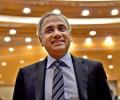
Infosys CEO Salil Parekh, has praised the company's founders for building an "incredible organisation", and exuded confidence that the firm which "has always been solid" will "continue with that stability." Parekh - who steered the firm to stability after a bitter spat between founders and then-management a few years back - believes that Infosys is "well positioned" to leverage tech-led growth opportunities over the next several years. Parekh took over at the helm in January 2018, after a standoff between board and founders, including NR Narayana Murthy, over issues such as governance, led to the exit of then-CEO Vishal Sikka.
As a result, the forecast of eight per cent retail inflation by January next year looks achievable.

That's why he is now finally focusing on the two things that alone can help: Fiscal expansion -- from December onwards -- and supply management via amended laws and rules that affect business, notes T C A Srinivasa-Raghavan

What's different this time is that global financial stress -- which has its genesis in four policy choices made in recent years -- is juxtaposed with a more resilient real economy, observes Sajjid Z Chinoy, chief India economist at J P Morgan.

The president outlined the government's agenda in the coming financial year in his customary address to the joint sitting of both the Houses of Parliament.

Finance Minister P T R Palanivel Thiagarajan has proclaimed his determination to set Tamil Nadu's fiscal house in order in five years, and Friday will show how he plans to go about it when he rises to present the Stalin government's maiden budget, says N Sathiya Moorthy.

American brokerage firm Morgan Stanley on Thursday sharply cut its India FY23 real GDP growth estimate to 7.9 per cent, mainly due to the impact of the Russia-Ukraine conflict on oil prices. Analysts at the brokerage also raised their inflation forecast to 6 per cent - the upper end of the tolerance band for the RBI - and flagged stagflation risks because of the ongoing events. "We believe that the ongoing geopolitical tensions exacerbate external risks and impart a stagflationary impulse to the economy," they said. It can be noted that stagflation involves a stagnancy in output or growth, coupled with high inflation.

Bank credit offtake is expected to pick up following normalisation of economic activities aided by the government thrust on public expenditure in current fiscal year, a report said. According to the Care Edge report, the gross non-performing assets (GNPA) ratio hit a six-year low of 5.9 per cent in FY22 but remained above the pre-asset quality review of 2015-16. However, it said, India's NPA ratio is one of the highest among the comparable countries despite gradual decline.

While the collapse of a large financial intermediary can wreak havoc on the system because of the interconnectivity, a large business conglomerate too can play spoilsport if the banks have too much exposure to the entity, explains Tamal Bandyopadhyay.

For all its claims to economic glory, the majority of India's population lives vulnerable lives, a situation that has only worsened over the past 15 years, to the extent that the government now fears to release economic data or even conduct a proper Census, notes Rathin Roy.

'I'm pitching India for the strengths we offer, including the English language, engineers, doctors, nurses, professionals, innovative talent of startups.'

PEs and VCs are taking a closer look at their bouquet of investments. Leading voices in the sector are categorical that cash-burn rates -- that's blowing up equity to acquire market share -- as a business model can't continue to be the polestar.

Reserve Bank Governor Shaktikanta Das on Friday said 67 per cent of the decline in the foreign exchange reserves since April was due to valuation changes arising from strengthening US dollar and higher American bond yields. The forex reserves, which stood at $606.475 billion as on April 2, have declined to $537.5 billion as on September 23. It was also the eighth straight week when the reserves declined.

'We get to know secrets such as some of India's top-rated firms do not always make payments when due and many State-owned, listed, enterprises that borrow in bond markets default regularly.' 'Without naming the bank, he says that ever-greening of poor loans by a part of India's shadow banking lay at the doorstep of India's banking, notably 'one private bank'.' Viral Acharya's Quest for Restoring Financial Stability in India won't be music to many ears, observes Tamal Bandyopadhyay.

The Reserve Bank will go for a "dovish pause" at Wednesday's policy review announcement amid developments such as a rise in inflation, government maintaining the inflation target band and a likely impact on growth due to local lockdowns on rising COVID-19 infections, analysts said on Monday. Economists at American brokerage Bofa Securities said price stability, growth and financial stability will become the prime focus areas for the central bank going forward. "The RBI MPC (Monetary Policy Committee) should deliver another dovish pause on Wednesday," it said. The policy announcement, the first for the fiscal, will come days after the government maintained the RBI's target to ensure inflation to be within 2-6 per cent band for five more years.

Nirmala Sitharaman is proving to be a better finance minister than her initial rookie status might have led people to expect, observes T N Ninan.

Observing that India's worsening COVID-19 situation and the strict measures to contain it have hit the economy hard, the rating agency said productive capacity has been severely disrupted since the start of the pandemic.

India's economic image is not affected due to Adani Group's recent decision to pull out Rs 20,000 crore FPO (follow-on public offers) amid allegations of financial wrongdoings, Finance Minister Nirmala Sitharaman said on Saturday.

Despite its admirable competence and proven track record, the RBI doesn't have the capacity to supervise an economy that's growing so fast and becoming larger by the year, points out T C A Srinivasa Raghavan.

India's exports may have touched an all-time high of $422 billion in 2021-22 but recession in key western markets and geo-political crisis due to the Russia-Ukraine war are expected to impact the growth of the country's outbound shipments in 2023. All the global trade promoting factors like political stability, movement of goods, adequate availability of containers and shipping lines, demand, stable currency and smooth banking systems are in disarray. Adding to the woes, COVID cases have again started rising in countries like China, Japan, South Korea and the US.

India's services sector activities touched the highest mark since April 2011 amid ongoing improvements in demand conditions, even as cost pressures in the service economy remained stubbornly high, a monthly survey said on Tuesday. The seasonally adjusted S&P Global India Services PMI Business Activity Index rose from 58.9 in May to 59.2 in June -- its highest mark since April 2011. For the eleventh straight month, the services sector witnessed an expansion in output. In Purchasing Managers' Index (PMI) parlance, a print above 50 means expansion while a score below 50 denotes contraction.

In years past, we often approached the Budget expecting to see changes in direct and indirect taxes. Those days are behind us. The Budget of today seeks to expand the economy and keep it at the forefront of technology, observes Harsh Goenka.
ITC has been one of the best performing large-cap stock at the bourses thus far in calendar year 2022 (CY22), rallying nearly 52 per cent during this period and outperforming the sector benchmark - the S&P BSE FMCG index - by a wide margin that moved up around 17 per cent during this period. However, the counter has lost over 5 per cent from its recent high of Rs 346.25 hit on September 23, 2022 and has underperformed the S&P BSE Sensex, which has lost nearly 2 per cent since then. So, is the rally in the stock coming to an end, and is this a good time to book profit?

India, he said, has already taken a host of reforms in banking and other sectors and is now focussing on stepping up public investment. "Compared to other nations, even among advanced countries, I think India is relatively better placed for the simple reason that India paid a certain price last decade... we had a banking system stress which was then compounded by stress in the non-banking financial sector towards 2018," he said at Amazon Smbhav Summit.

A few years ago, when top officials of Indian state-run refiners went to Dubai to negotiate a crude oil supply contract, a senior official from state-owned Saudi Aramco told them, "We can negotiate on anything, but I am the last man standing for you. "Nobody can offer the range of crudes we do with certainty," an official who was part of the negotiating team recalls. Perhaps that explains why Saudi Arabia is less concerned about losing its place as India's premier oil supplier to an upstart like Russia, which emerged from nowhere to become India's biggest crude oil supplier in September and October.

Days after the US Fed raised the interest rate, the RBI may go in for its third consecutive policy rate hike by at least 35 basis points to check high retail inflation, experts said. The central bank has already announced to gradually withdraw its accommodative monetary policy stance. The Reserve Bank of India's rate-setting panel -- the Monetary Policy Committee -- will meet for three days from August 3 to deliberate on the prevailing economic situation and announce its bi-monthly review on Friday.

A revival in investment is likely to be a key near-term initiative.

India remains an attractive destination for foreign direct investments (FDI) on account of healthy prospects of economic growth and its skilled workforce, according to a survey by Deloitte. A large proportion of international business leaders remain confident in India's short- and long-term prospects and are readying plans to make additional and first-time investments in the country, it said on Tuesday. "The survey, which questioned 1,200 business leaders of multinational corporations in the US, UK, Japan and Singapore, found that India remains an attractive destination for investments, scoring highly for its skilled workforce and prospects for economic growth," the survey - India's FDI Opportunity - said.

India's economy will do well once vaccination reaches a critical mass as pent up demand, global recovery and easy financial conditions will boost activities, RBI's Monetary Policy Committee (MPC) member Ashima Goyal said on Tuesday.

PSU divestment, LIC IPO, fiscal deficit: Budget 2021 marks a clear change in the Modi government's stance from fiscal conservatism to growth orientation.
